
Building Better Athletes By Design
More and more professional athletes are turning to Pilates and incorporating this in their training regimen. But why is that?
Here are just a few of the reasons and if you want to find out more read the following article at Sports Illustrated.
At the Core is the Core

Pilates was designed from the very outset to develop our Core in order to provide a strong, flexible framework from which our other structures hang. Arms, legs and shoulder girdle — these all depend on the Core for their stability.
Developing a solid Core is one of the major reasons elite athletes turn to Pilates. With your Core strong and stable you have a solid base from which to develop your technique, stamina and strength.
Pilates can deliver big dividends in this regard. “Pilates seems to activate the deeper abdominal muscles more than conventional gym exercises,” says Duncan Critchley, a lecturer and exercise researcher at King’s College London. Research from Spain also shows that Pilates helps eliminate “asymmetries” in the abdominal muscles that line the sides of your torso.
Mind and Body in Harmony

It is one thing to have a strong core but to convert that to superior athletic performance needs fluidity of movement and control. Pilates reinforces the bond between mind and muscle, building awareness of which muscles are working and how to activate the ‘correct’ muscles to provide movement and stability. The use of the Reformer and other STOTT PILATES® equipment helps us to internalise these connections more quickly and as these ‘muscle memories’ develop, they become directly transferable to our chosen sport.
One of the key concepts of Pilates is called “centreing,” or understanding that all movements originate in your core. “Like yoga, it’s about breathing and focus and being mindful of your body’s movements,” says Ann Gibson, an associate professor of exercise science at the University of New Mexico. At least one study has linked Pilates to enhanced mindfulness and something called sensory awareness, which may induce relaxation, mood improvements and stress reduction.
A Little Balance in Your Life
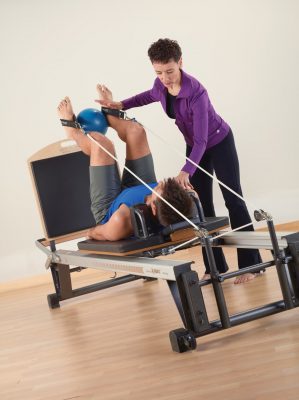
Many sports injuries arise from inherent instability in an athlete’s anatomy. Training particularly hard in a limited set of muscle groups can both cause imbalances with opposing muscle groups and also reduce flexiblity, both of which can lead to injury. A well designed Pilates programme will combat these imbalances, restore postural alignment and create a solid foundation for any sports person to build upon in their training.
Cherie Wells, a senior lecturer in physical therapy at Australia’s Griffith University has found that the core-strengthening perks of Pilates may also ease pain and improve daily life for people suffering from chronic low-back pain.
Time to Get Going
Like all exercise systems, Pilates requires movements to be performed correctly. Proper instruction and encouragement is key to success, as is having a well-designed programme that is built around you and your particular needs and problems.
“If you want to experience all these advantages, good form is essential”, says Marie-Louise Bird, a Pilates researcher and post-doctoral research fellow at the University of British Columbia. That requires a good teacher. “Results come from a structured class taught by a certified instructor,” says Ann Gibson, who warns newbies not to assume they can pick up Pilates by looking at a few online pictures or guides. “There needs to be a lot of focus on rolling down or up from the ground, one vertebrae at a time.”

“Now, where could I find a fabulous Pilates Class taught by a former world class athlete that was at the pinnacle of her sport. Let me think now?”
What Top Flight Athletes Say About Pilates
Still not convinced? See what a few of the many top flight athletes using Pilates have to say about it: